
Meade Parole and Probation Compared
Kansas uses several forms of supervision, and the label controls where a record is found. Parole is a discretionary release used for eligible people serving older, indeterminate sentences. Postrelease supervision follows the prison part of most determinate guideline sentences for crimes committed on or after July 1, 1993. Probation is a court order that allows a person to remain in the community under set terms. Community corrections may supervise higher-risk probation cases, but it is not the same as parole.
The distinction matters in Meade County. The Kansas Department of Corrections, or KDOC, maintains parole and postrelease data in KASPER. A district court file is usually the stronger starting point for probation. KASPER warns that current community-corrections events after April 21, 2021 cannot be displayed because of a data-system change. A blank or old probation entry there is not proof that supervision ended.
| Status | Who orders it | Best first record |
|---|---|---|
| Parole | Prisoner Review Board for an eligible older sentence | KASPER and the assigned parole office |
| Postrelease supervision | Follows a determinate prison term under Kansas law | KASPER and KDOC |
| Probation | District or municipal court | Court order and supervising agency |
| Final discharge | KDOC or the court, depending on the case | Discharge certificate, KASPER, or court order |
- Parole
- Conditional release from the prison part of an eligible indeterminate sentence.
- Postrelease
- A set supervision term that follows many determinate Kansas prison sentences.
- Probation
- Court-ordered supervision in the community.
- Discharge
- The documented end of the represented sentence or supervision obligation.
Check Meade County Parole Records
KASPER, the Kansas Adult Supervised Population Electronic Repository, is the public search for KDOC-associated cases. It is more than a prison roster. Its supervision menu includes Parole, Discharged, Community Corr., Absconder, Inmate, and other categories. It updates each working day, so an office can hold newer information than the public screen.
- Accept the KASPER disclaimer and search by KDOC number when known.
- Otherwise use full name, birth date, and alias search. Compare stable identifiers before relying on a result.
- Open Advanced Search and choose Parole, Discharged, or All. “Meade” as conviction county identifies the case county, not the person’s current home.
- Read current status, status date, supervision location, case lines, and movement history together.
- Contact the listed parole office for a same-day change. Ask KDOC for a discharge certificate when formal proof is needed.
A Meade County Jail release will not always appear in KASPER. Someone who bonded out, finished a local jail sentence, or had a local case dismissed may never have a KDOC-associated record. Conversely, a person who left the jail for state intake has not been released to the community. The jail transfer entry and later KASPER record describe two stages of the same custody path.
The Meade County released inmate search and records overview explains how to combine the jail event, court order, and receiving-system record when the path is unclear.
Meade Supervision Office Assignment
The KDOC parole office directory assigns Meade County coverage to the Garden City Parole Office. Coverage by county is a useful routing point, but it does not prove that every person convicted in Meade reports there. Office assignment follows the approved release or supervision location, which can differ from conviction county.
816 N. Campus Drive, Suite 500
Garden City, KS 67846
620-960-1275
The official directory image shows the statewide contact route and the office serving Meade County. Review the KDOC parole office lookup before using an address from an old court paper.

The office listing should be matched to the KASPER supervision location. If those sources differ, ask KDOC which office currently holds the case rather than assuming the county label is current.
Probation follows another route. Search the Kansas District Court case for a probation order, revocation filing, or discharge order. Then use the supervising agency named in that record. The KASPER disclaimer’s community-corrections limitation makes the court file and agency confirmation especially important for recent Meade County probation events.
Meade Parole Absconder Status
KDOC maintains a separate parole absconder search. Kansas law defines absconding as knowingly avoiding supervision or knowingly making one’s whereabouts unknown to the supervising officer. An absconder entry reports an alleged supervision problem. It does not show that the person is now confined, and it should not be treated as a live jail roster.
The official absconder screen can filter by last supervision location, including Kansas counties, facilities, federal jurisdiction, and other states. The KDOC search interface illustrates why the last supervision location is not always the same as the offense county.
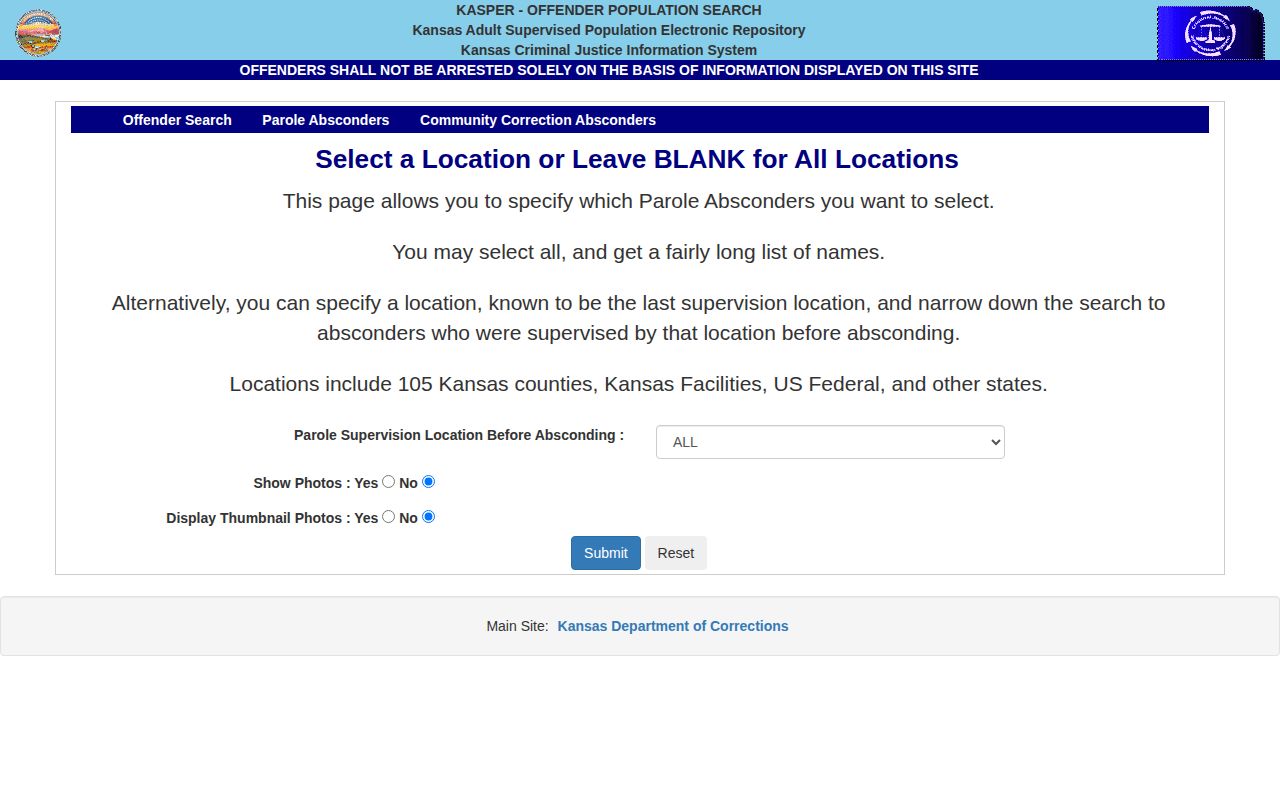
After a match, compare name, KDOC number, and supervision location. Current custody must be checked in the system that would hold the person. KDOC lists its Enforcement, Apprehensions, and Investigations Unit at 785-414-7755 for information, but the public listing alone cannot establish an arrest or return date.
Meade Parole Hearing Records
The Prisoner Review Board handles parole decisions for eligible indeterminate cases. Most people serving determinate guideline sentences do not use this discretionary parole-hearing path. The Board may still set conditions in postrelease matters, but K.S.A. 22-3717(i) says it cannot advance or delay a determinate release date.
KDOC posts monthly public-comment and hearing schedules and a separate listed-offender page. A listed Meade County case means the county of offense is Meade. It does not identify a future residence, a reporting office, or a confirmed release destination. The list contains eligibility information, not the final outcome.
Eligibility also differs from suitability. KDOC may consider the offense, prior record, conduct and programs in prison, evaluations, public comments, staff recommendations, and release planning. Its published outcomes are parole, continue, or pass. “Continue” allows more review; “pass” denies parole for a stated period. No current official person-by-person decisions search was found. Check later KASPER status and request the specific Board record when the outcome matters.
Even a parole decision does not prove that the person left prison on the hearing day. Eligibility dates, release plans, and processing still control actual movement. The KASPER status and the assigned office provide the next checkpoints.
Meade Supervision Violations and Holds
A new violation can change the status without erasing the earlier release. A warrant, revocation filing, court order, or return to custody may appear in different systems at different times. KASPER updates on working days. A parole office can therefore know about a change before it reaches the public record.
For probation, inspect the court register of actions for an allegation, warrant, hearing, revocation, or amended order. A filing is not the same as a final ruling. For parole, compare KASPER with the absconder search and the current custody source. Kansas VINE covers adults in county jails, but it expressly excludes KDOC offenders housed in state prisons. Each system answers only its own question.
Conditions themselves may include reporting and other case-specific duties. Do not infer a person’s exact terms from a standard list. The signed order, parole certificate, or supervising agency record controls. If a status appears wrong, identify the exact field and provide the agency with the case number, KDOC number, date, and supporting document. KASPER directs accuracy questions to kdoc_pub@ks.gov.
When Meade Supervision Ends
Release from prison is not the same as final discharge. A KASPER status of Parole means the prison portion has ended while state supervision remains. An indeterminate-sentence person can stay supervised until the maximum term expires. KDOC explains that at least one year of supervision ordinarily comes before an early-discharge request.
K.S.A. 22-3722 permits the Board to issue a final discharge order and certificate, generally not less than one year after release unless the sentence expires sooner. A KASPER “Discharged” status and date provide a public trace. A discharge certificate is stronger documentary proof when the exact end of KDOC supervision matters.
Read that discharge narrowly. It applies to the KDOC obligation represented in the record, not every possible matter in another county or jurisdiction. Verify identity through KDOC number, birth date, conviction county, and case lines. For probation, look for the court’s discharge or termination order and confirm it with the clerk or supervising agency.
A released person may remain visible in KASPER after supervision ends. KDOC retention schedules state that some information remains permanently public, while selected documents can be retained for years after the full inmate file is purged. Historical visibility does not mean supervision remains active. Current status, its date, and the underlying order must be read together.
Note: A final discharge record ends the represented obligation; it does not rewrite the earlier custody and supervision history.