
Meade Scheduled and Actual Release
KASPER uses the exact label “Earliest Possible Release Date.” It is prospective and conditional. A later “Discharged Date” looks backward and records the end of the represented KDOC obligation. Neither should be relabeled. A court sentence, parole eligibility date, projected prison release, jail release timestamp, and final discharge date are separate facts.
| Date | Meaning | Best source |
|---|---|---|
| Earliest possible release | Conditional state-prison projection | KASPER |
| Parole eligibility | Older sentence may be considered | PRB and statute |
| County release time | Physical departure from Meade Jail | Sheriff custody entry |
| Discharged date | KDOC obligation ended | KASPER or certificate |
Find Meade State Release Dates
Use KASPER for a person delivered to KDOC. It includes KDOC-operated or funded cases and updates each working day. It is not a complete Kansas history and will not contain every local jail sentence.
- Accept the disclaimer and search by KDOC number, or use full name, birth date, and aliases.
- Compare stable identifiers and the Meade conviction-county case lines.
- Open the detail record and quote “Earliest Possible Release Date” exactly.
- Review status, sentence lines, movement history, and supervision information.
- Recheck status after the date and confirm a fresh change with KDOC or the listed parole office.
The official KASPER detail example shows where the field appears.
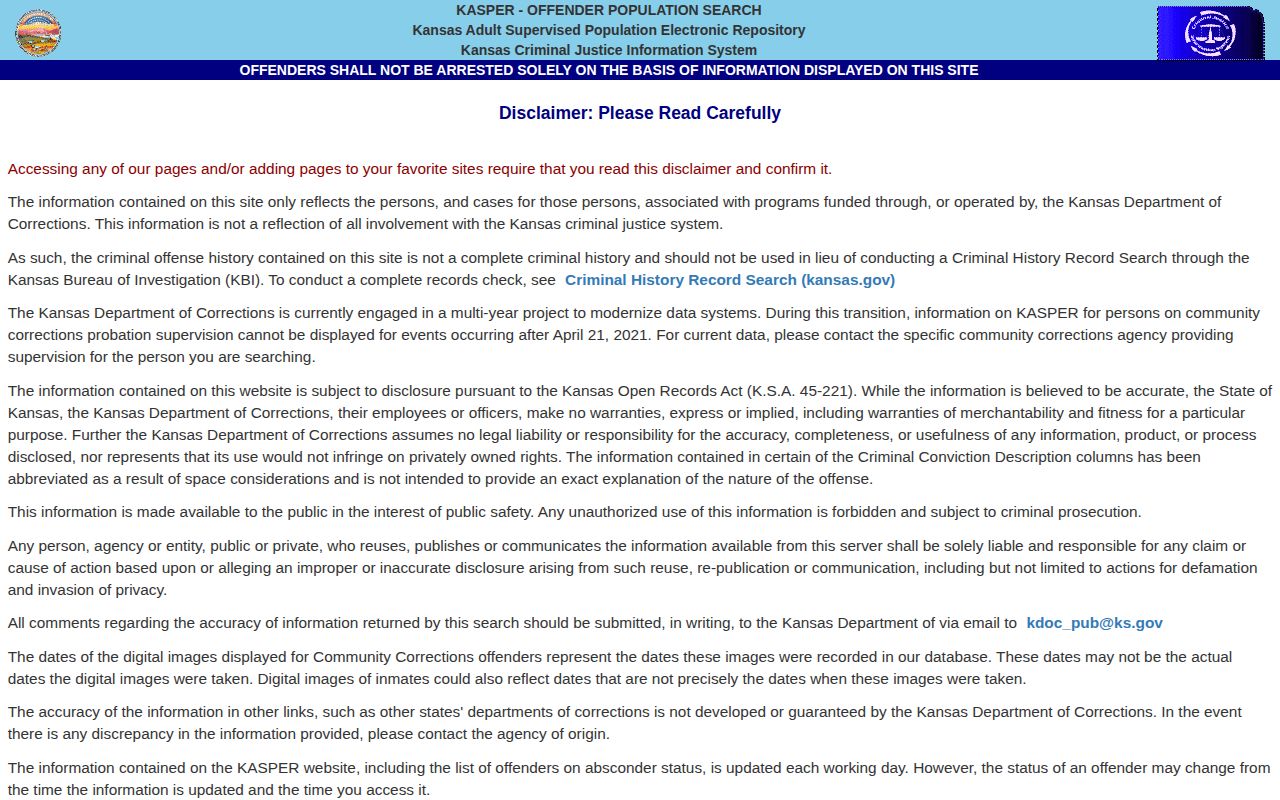
The image demonstrates the field label, not the circumstances of any Meade County person. Identity and the current case must be checked independently.
Meade Jail Release-Date Records
A pretrial person has no fixed release date merely because bond is set. Release can await posting, processing, and clearance of other holds. A sentenced county-jail inmate may have a term and jail credit in the journal entry, but no official Meade jail good-time policy was found. Do not apply KDOC percentages to a local jail term.
Call the Meade County Sheriff at 620-873-8765 and request the recorded calculation or release entry. The county open-records form can identify the booking sheet, custody history, release date and time, release type, and receiving agency. Compare that response with the court sentence.
Meade Jail also holds Clark County arrestees and people awaiting KDOC transport. Identify both the charging court and holding facility. A departure for state intake is a transfer, not a community release.
Kansas Credits Affect Meade Dates
K.S.A. 21-6821 supplies the current KDOC good-time and program-credit framework. For many guideline sentences, up to 15 percent good time creates the familiar 85 percent shorthand only when credit is earned and kept. Certain lower-severity cases can have a 20 percent maximum. Mandatory, off-grid, and older indeterminate sentences differ.
Program credits may apply within statutory limits. Credits can be withheld or forfeited. Sentence aggregation, jail credit, revocation, and a new court action may also change the calculation. For crimes before July 1993, K.S.A. 22-3725 can govern older good-time rules. No single percentage fits every Kansas sentence.
Parole eligibility is different again. The Prisoner Review Board considers eligible indeterminate cases, while most determinate releases do not depend on a discretionary parole hearing. A monthly hearing list is not a release list or decision.
Earned credit is conditional by design. A maximum percentage does not mean the full amount has been awarded. Conduct, participation, offense date, sentence type, and statutory limits can affect the calculation. The KASPER field reflects current inputs, not a promise that future credits will remain.
County-jail time requires a separate analysis. No official Meade County jail good-time formula was found. A state-prison percentage should never be copied onto a local sentence. Ask for the Sheriff’s calculation and compare it with the court’s sentencing entry and jail credit.
Why Meade Release Dates Move
A projected date is recalculated when the legal or custodial inputs change. The public record may lag the agency’s current calculation.
| Change | Possible effect | Confirm through |
|---|---|---|
| Good-time gain or loss | Moves conditional date | KDOC record |
| Program credit | Reduction within statutory cap | KDOC |
| Detainer or hold | Prevents community release | Holding and receiving agencies |
| New court order | Changes sentence or credit | Court docket |
| Parole decision | Affects eligible older sentence | PRB and later KASPER status |
| Revocation | Returns person to custody or recalculates time | Court or KDOC |
A bond order can authorize release before jail processing ends. Likewise, reaching the earliest possible date does not prove the person cleared all holds. Current status must be checked after the projection.
Meade Release-Date Record Trail
When sources disagree, use the record closest to the fact. A sentencing journal entry states the lawful term and may award jail credit. KDOC calculates the state sentence and records movements. The Sheriff records when a person leaves Meade County Jail. A parole office can confirm a new event before KASPER updates.
The Kansas District Court Case Search identifies case status and the register of actions. Look for sentencing entries, amended orders, revocations, and jail-credit findings. A docket may explain why a date changed without showing when facility processing ended.
A missing online document does not prove the event never occurred. Contact the clerk when a listed entry has no public image. Sealed, expunged, juvenile, and restricted material may remain unavailable.
Meade State Release Supervision
Leaving a KDOC prison often begins supervision rather than ending the sentence. KASPER may change from Inmate to Parole. The Garden City Parole Office covers Meade County, although assignment follows the approved supervision location rather than conviction county.
Final discharge is distinct. K.S.A. 22-3722 permits a discharge order and certificate for an eligible parole case, generally after at least one year unless the sentence expires sooner. A KASPER “Discharged” status documents the represented KDOC obligation.
Retention rules explain why a released person can remain searchable. Some KASPER information stays permanently public. Historical display does not mean current custody or supervision.
Meade Sentence Calculations Differ
Consecutive terms run one after another, while concurrent terms run at the same time. The court order controls that structure. Jail credit can reduce time owed, but the credited days and effective start date must come from an official calculation.
Older indeterminate sentences add a Board decision. A monthly hearing list shows eligibility, not release. The outcome may be parole, continue, or pass. Even parole remains subject to the eligibility date, release planning, and processing.
A detainer is a request or legal basis for another agency to hold or receive the person. It can block community release after the current sentence ends. Ask whether another jurisdiction is listed.
Confirm Meade Actual Release Dates
Start the final check in the system that held the person. For Meade County Jail, request the Sheriff’s custody-history or release entry. For a Kansas prison, reopen KASPER and compare current status with the earlier projection. A passed date without a release status may reflect lost credit, recalculation, a hold, revocation, or another legal event. Do not report the old projection as actual release.
If the jail record says transfer, identify the receiving agency. A KDOC transfer should lead to KASPER after intake. Another county requires that county’s custody source. A federal transfer can involve a federal docket or U.S. Marshals custody before a BOP record appears. Each branch has its own scope and update schedule.
Court disposition is supporting evidence. A bond entry can show release was authorized, but another warrant or hold may delay physical departure. A dismissal ends the identified case without necessarily ending custody on another matter. The sentence journal gives the term, while the facility records the exit timestamp.
When a copy matters, ask for an existing record instead of a new calculation. For the county, identify the booking sheet, release log entry, or custody history. For KDOC, identify the status record, movement entry, parole certificate, or discharge certificate. Include full name, date of birth if known, case number, and the KDOC or booking number.
Record the date on which each source was checked. A court order can precede jail processing, and KASPER can trail a same-day state movement until the next working-day update. If two records appear to conflict, ask the originating offices about timing and scope before deciding that either entry is inaccurate.
For a county release, the Sheriff entry records physical departure and the court explains legal authority. For a KDOC release, read the KASPER status and movement history, then contact the assigned office if the change is fresh. “Parole” means release under supervision; “Discharged” means the represented KDOC obligation ended.
VINELink release alerts cover adults in Kansas county jails but exclude state-prison offenders. They can prompt confirmation, yet they are not a durable release certificate. For a full identity-based path across jail, court, and state records, use the Meade County released inmate search.
Note: Quote the source’s date label and scope; do not turn a conditional projection into a guaranteed release.